
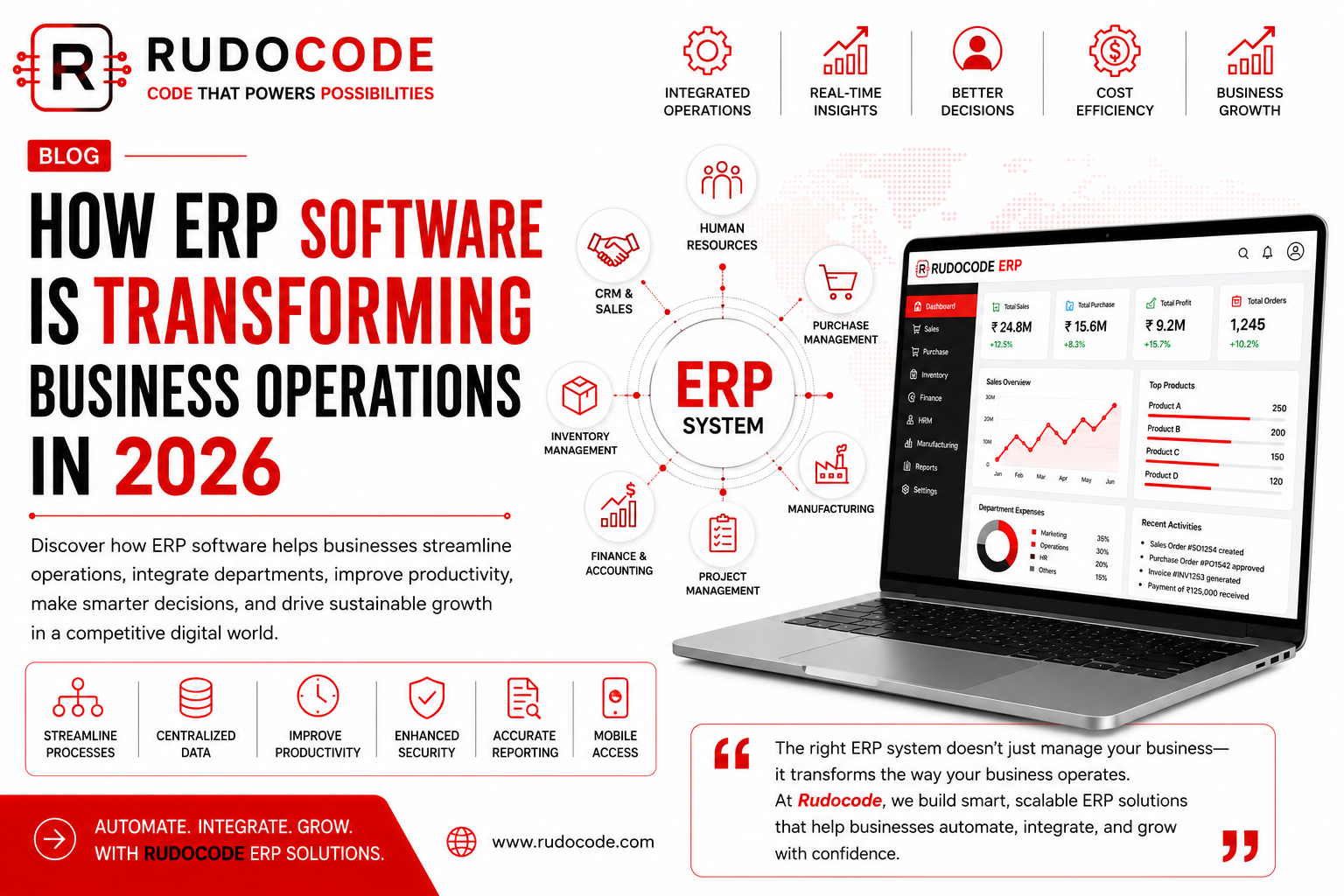
How ERP Software is Transforming Business Operations in 2026
In today's fast-paced business environment, managing multiple departments, processes, and data sources can be challenging. As businesses grow, maintaining efficiency and visibility across operations becomes increasingly important. This is where Enterprise Resource Planning (ERP) software plays a crucial role.
ERP systems help businesses integrate various departments such as Sales, Finance, Inventory, Human Resources, Purchasing, and Operations into a single centralized platform. In 2026, ERP has become one of the most valuable tools for organizations looking to improve productivity, reduce costs, and drive business growth.
What is ERP?
ERP (Enterprise Resource Planning) is a business management software that centralizes company data and automates core business processes. Instead of using separate systems for different departments, ERP provides a unified platform where information flows seamlessly across the organization.
This enables businesses to operate more efficiently while maintaining complete visibility into their operations.
Key Benefits of ERP Software
1. Centralized Business Data
ERP creates a single source of truth for all business information. Teams can access real-time data without relying on spreadsheets or disconnected systems, reducing errors and improving collaboration.
2. Improved Operational Efficiency
By automating routine tasks such as inventory tracking, invoicing, payroll processing, and reporting, ERP reduces manual effort and allows employees to focus on more strategic activities.
3. Better Decision-Making
ERP systems provide real-time dashboards and analytics that help business leaders monitor performance, identify trends, and make data-driven decisions.
4. Enhanced Customer Service
With access to complete customer information, businesses can respond faster to inquiries, process orders efficiently, and deliver a better customer experience.
5. Scalability for Business Growth
As businesses expand, ERP systems can grow with them by supporting additional users, departments, and business processes without requiring major system changes.
Industries That Benefit from ERP
ERP solutions are widely used across industries, including:
Manufacturing
Retail & E-commerce
Healthcare
Education
Logistics & Transportation
Construction
Professional Services
Wholesale Distribution
Regardless of industry, ERP helps organizations improve efficiency, visibility, and control over their operations.
Why Businesses Are Investing in ERP in 2026
Modern ERP solutions offer cloud accessibility, mobile support, automation, artificial intelligence, and advanced analytics. Businesses are increasingly adopting ERP systems to stay competitive, improve productivity, and adapt to changing market demands.
Companies that implement ERP successfully often experience:
Reduced operational costs
Faster business processes
Improved team collaboration
Better reporting accuracy
Increased profitability
How Rudocode Helps Businesses with ERP Solutions
At Rudocode, we develop customized ERP solutions designed to meet the unique needs of modern businesses. Whether you need Inventory Management, HR & Payroll, CRM Integration, Finance Management, Manufacturing Processes, or a complete business automation system, our team can build scalable ERP software tailored to your operations.
Our goal is to help businesses streamline workflows, improve productivity, and achieve sustainable growth through innovative technology solutions.
Conclusion
ERP software is no longer just an option for large enterprises. In 2026, businesses of all sizes are leveraging ERP systems to improve efficiency, centralize data, and make smarter decisions. By integrating key business functions into a single platform, ERP empowers organizations to operate more effectively and prepare for future growth.
The right ERP system doesn't just manage your business—it transforms the way your business operates. At Rudocode, we build smart, scalable ERP solutions that help businesses automate, integrate, and grow with confidence.